In today’s world, being good at just one thing isn’t enough. You need to know how to think, build, sell, and adapt — all at once. That’s what I share in my AI newsletter and community. You’ll learn how to automate tasks, create products, grow businesses, and lead teams — using AI. I’ve worked hands-on across 5+ industries and almost every business role. Everything I share is simple, useful, and straight from experience. Join 5,000+ people learning how to stay sharp, flexible, and future-ready.
Share
🤖 Anthropic deploys Claude as automated interviewer
Published 8 days ago • 5 min read
The Creators Hive: AI News, Tools & Tips — Curated for Modern Creators and Innovators
Greetings Qrew,
Whether you're diving into AI for work, side projects, or just out of curiosity — this issue of The Creators Hive brings you practical insights, hands-on learning, and tools you can actually use.
Anthropic deploys Claude as automated interviewer
Enterprises adopt agentic AI after OpenAI Accenture deal
Anthropic has launched “Anthropic Interviewer,” a tool that uses Claude to run structured research interviews at scale. The system helps the company and external researchers study how professionals use AI and how they feel about its role in their work.
Key details:
Claude generates interview plans tailored to specific research questions and then conducts adaptive, real-time interviews with participants.
Human researchers review and refine the AI’s interview plan and later analyze the collected responses.
Interviews typically last 10 to 15 minutes and are offered to Claude.ai users through in-product prompts.
Anthropic is making anonymized data from these interviews available to researchers studying AI’s economic and social impact.
Why it matters: Using an AI model as a “research interviewer” allows large-scale qualitative studies that would be hard to run manually. Insights from these interviews can shape how future AI systems are designed, governed and integrated into workplaces.
OpenAI and Accenture have formed a global partnership to help large companies adopt “agentic” AI systems that can take actions across business workflows, not just generate text. Accenture will roll out ChatGPT Enterprise and OpenAI agent tools to tens of thousands of its own staff and embed them into client operations.
Key details:
The collaboration focuses on building AI agents for core functions such as customer service, supply chain, finance and HR.
Accenture will use OpenAI’s AgentKit and implementation playbooks to help clients rapidly design, test and deploy custom AI agents.
OpenAI gains a large-scale enterprise channel as Accenture supports it in scaling AI deployments across industries.
The deal positions agentic AI as a pillar of “enterprise reinvention,” aiming for measurable productivity and growth gains.
Why it matters: This partnership signals that autonomous AI agents are moving from experiments into large, production-scale enterprise systems. It sets a template for how advanced AI will be integrated into everyday business processes globally.
Researchers have shown that machine learning can safely control a free-flying robot inside the International Space Station, improving its ability to navigate cluttered environments. This builds on earlier ISS experiments where astronauts coordinated intelligent robots for complex exploration tasks.
Key details:
A Stanford-led team demonstrated that learned control policies could guide a robot through the ISS while respecting strict safety limits.
The work focuses on navigation in tight, changing spaces, which is similar to conditions expected in future orbital and planetary habitats.
Previous “Surface Avatar” experiments linked an ISS astronaut with semi-autonomous robots in a Mars-like test site on Earth.
AI assistants such as “Neal AI” were used to support astronauts in understanding and operating robotic systems.
Why it matters: Better autonomous navigation reduces the need for constant human supervision of robots in space. This can make future missions to the Moon and Mars safer and more efficient, with robots handling more construction, maintenance and exploration tasks.
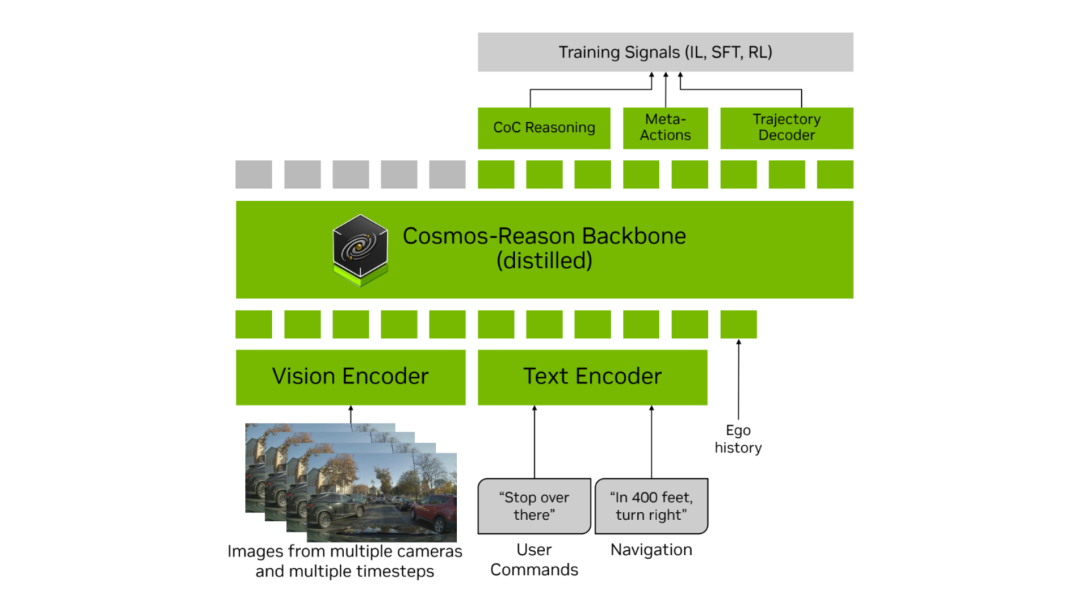
Nvidia has released Alpamayo R1, an open AI software model for self-driving cars that combines “vision, language and action” to reason about road situations. The model is available as open source for research and non-commercial use.
Key details:
Alpamayo R1 is a vision language action (VLA) model that turns sensor inputs into natural language descriptions and driving actions.
It uses “Chain of Causation” reasoning and trajectory planning to handle complex or rare driving scenarios more safely.
Nvidia and analysts say the model is aimed at pushing toward Level 4 autonomy, where vehicles can drive themselves in defined areas.
Model weights and code are published to support universities, startups and labs working on interpretable autonomous driving.
Why it matters: Open access to a state-of-the-art driving model could speed up innovation and safety research in autonomous vehicles. It also reflects a shift toward more transparent, explainable systems that show how AI “thinks” about the road, not just what control command it outputs.
Meta Platforms has acquired Limitless, a startup known for AI-enabled wearable devices that record and transcribe real-world conversations. The deal is aimed at strengthening Meta’s push into AI-powered consumer hardware.
Key details:
Limitless previously built a pendant-style or clip-on device that captures audio and turns it into searchable, AI-processed notes.
Meta plans to use Limitless technology to advance its next generation of AI-enabled wearables.
The acquisition aligns with Meta’s vision of “personal superintelligence” delivered through everyday devices like smart glasses.
Limitless will focus on supporting Meta’s existing AR and AI products rather than continuing to sell its own pendant as a standalone product.
Why it matters: The deal underlines how important AI-enabled wearables are becoming in Big Tech’s strategy after smartphones. It also raises fresh questions about privacy, data protection and regulation when devices can continuously capture and analyze everyday conversations.
Tailornova is a web-based 3D fashion design tool. On its website, you can draw clothing designs, preview them in 3D, and automatically get custom-fit sewing patterns. It works by using measurements you provide to create patterns ready for download. This lets you go from a design idea to a sewing-ready pattern without manual drafting.
What makes it unique?
It offers a customizable 3D “FitModel” based on actual body measurements so patterns match real sizes.
It converts a design sketch into production-ready patterns and cut-sheets in a matter of seconds.
Because it runs in a web browser, you don’t need to install heavy CAD software. This makes it accessible for independent designers, small studios, or hobbyists.
It supports many kinds of garments and allows a lot of customization-useful whether you are designing simple t-shirts or more complex outfits.
Use case magic
Boutique designers get full collections: 3D preview + ready-to-sew patterns.
Tailors generate made-to-measure patterns from exact customer measurements.
Sewing hobbyists make custom-fit clothes when ready-to-wear doesn’t fit.
Online brands easily produce small-batch or bespoke clothing via pattern-to-production pipeline.
Why it stands out
Tailornova simplifies garment creation by combining design, fitting and pattern making into one web tool. It removes the need for deep pattern-making skills or expensive software, letting anyone-from a home sewer to a small brand-create professional-quality garments. Its 3D visualization, custom-fit patterns and easy web access make fashion design more accessible.
Masterpieces from the Hive 🎨
Here’s what our community has been creating this week using the Hive Wall:
Prompt: a skyward angle of a sunset-golden sky with the ellipses of a sunray pointing down through palm fronds
Prompt: Ultra-luxury villa plot launch visual; golden sunrise over a premium gated community layout; wide 40-ft paved roads, lush landscaped avenues, dramatic top-down drone shot; elegant European-inspired entrance arch; warm cinematic lighting; rich contrast; soft lens flares; high-end real-estate aesthetic; 8K, hyper-realistic.
Prompt: A website in google name "Www.OfficialBirdGame.com" On the top bar, inside website there a text description say "Explore the world with any bird you choose!. Play with friends, have PvP, and know the story with the story mode! "With image of bird with background of mountain and a download button in under
Prompt: A futuristic digital illustration showing a glowing human brain connected to a smartphone through neon data streams, symbolizing smart website design and conversion psychology. Minimalistic UI elements floating around, tech-inspired blue and purple color palette, modern, high-quality, 3D render style.” The 7 Cs of Website Design: High-Converting Websites Pointers: Clarity, Consistency, Content,Credibility, Context, Convenience, Conversion
Thanks for reading!
Got feedback? Reply to this email and let us know. We read everything and are constantly improving based on your suggestions.
🚀 Level up your creativity with Qolaba AI. Stop switching between tabs. We are the all-in-one startup platform that combines top-tier Chat, Image, Video, and Audio models in one place.
I build with AI and (Meditation), and help others do the same.
In today’s world, being good at just one thing isn’t enough. You need to know how to think, build, sell, and adapt — all at once. That’s what I share in my AI newsletter and community. You’ll learn how to automate tasks, create products, grow businesses, and lead teams — using AI. I’ve worked hands-on across 5+ industries and almost every business role. Everything I share is simple, useful, and straight from experience. Join 5,000+ people learning how to stay sharp, flexible, and future-ready.
The Creators Hive: AI News, Tools & Tips — Curated for Modern Creators and Innovators Greetings Qrew, Whether you're diving into AI for work, side projects, or just out of curiosity — this issue of The Creators Hive brings you practical insights, hands-on learning, and tools you can actually use. OpenAI rolls out GPT‑5.2 for work Google tests “Disco” AI browser AI spending fears hit Bitcoin and stocks Google pays publishers for AI summaries AI helps wind farms spare birds Tool Recommendation...
The Creators Hive: AI News, Tools & Tips — Curated for Modern Creators and Innovators Greetings Qrew, Whether you're diving into AI for work, side projects, or just out of curiosity — this issue of The Creators Hive brings you practical insights, hands-on learning, and tools you can actually use. Trump Plans Order Blocking State AI Laws EU Launches Major Probe Into Google AI Tokyo Startup Claims World’s First AGI New Robot Lab Accelerates Science 24/7 Google Confirms AI Glasses Launch for...
The Creators Hive: AI News, Tools & Tips — Curated for Modern Creators and Innovators Greetings Qrew, Whether you're diving into AI for work, side projects, or just out of curiosity — this issue of The Creators Hive brings you practical insights, hands-on learning, and tools you can actually use. OpenAI’s "Code Red": Prioritizing Performance UNESCO’s New Framework for Ethical AI in the Judiciary Amazon Introduces Next-Gen AI Stack Smarter Tools and Faster Models Arrive in Gemini NVIDIA open...